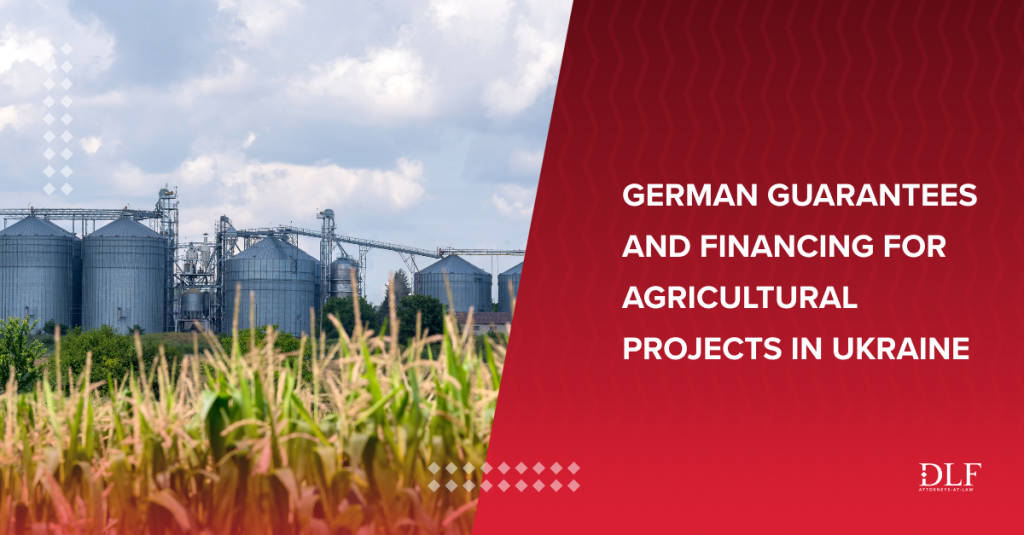
German investment guarantees can be an effective way to protect invested capital against a range of political and war risks. Export credit guarantees cover the risk of non-payment for deliveries, and DEG UkraineConnect provides loans for investments in Ukraine. Each instrument has its own eligibility criteria and requires separate approval.
This guide is for agribusinesses seeking European partners, foreign investors, equipment suppliers and the finance directors of these companies. It explains how financing and risk protection fit with Ukrainian rules on land rights, company structure, taxation and cross-border payments.
1. German financing and guarantee instruments
| Instrument | Administrator | Cover or financing | Target group |
|---|---|---|---|
| German federal investment guarantees | PwC on behalf of the federal government | Equity and loans qualifying under the guarantee terms. Cover for political and war risks | German companies with direct investments in Ukraine |
| Export credit guarantees | Euler Hermes Aktiengesellschaft on behalf of the federal government | Commercial and political risks of non-payment in export transactions | German exporters and banks financing exports |
| DEG UkraineConnect | DEG with financial support from BMWE | Loans for investment in Ukraine | Mid-sized businesses from Germany and elsewhere in Europe with a Ukrainian subsidiary |
2. German federal investment guarantees
German federal investment guarantees protect German direct investments against non-commercial risks.
Scope of cover. Cover may extend to equity and loans that qualify as equity-like under the programme rules. Eligible risks include expropriation, nationalisation, equivalent measures and war. Investors bear ordinary commercial losses.
The investor must notify the guarantee administrator without delay and in writing if the project faces a threat or circumstances increase the risk. Generally known war-related events do not require separate notification.
In the coverage policy for Ukraine, it is worth checking separately which currency and payment risks the guarantee covers for the return of capital and the payment of dividends.
Fees. The application fee for projects in Ukraine is waived until the end of 2027. However, the annual guarantee fee is still payable.
The bilateral investment protection treaty provides additional protection under international law. The grant and scope of a federal guarantee are determined separately under the programme rules.
3. German export credit guarantees
German export credit guarantees (Hermes cover) protect against commercial and political risks of non-payment in export transactions.
Two forms of cover are particularly relevant to agricultural projects.
- Individual transaction cover. This may be suitable for a delivery of combine harvesters, irrigation systems or grain storage equipment. The appropriate guarantee depends on the contract and payment terms.
- Wholeturnover cover (APG). This covers recurring short-term deliveries under a single policy, subject to buyer limits and reporting requirements.
Ukraine APG can cover short-term deliveries to different Ukrainian buyers without requiring the exporter to spread its portfolio across several countries. Applications are assessed individually. This cover is for exporters that supply goods regularly and have no existing APG policy. The coverage terms for Ukraine exclude standalone services and services supplied with goods where the services are invoiced separately.
4. Loans under DEG UkraineConnect
DEG, a subsidiary of German development bank KfW, runs UkraineConnect. Germany’s Federal Ministry for Economic Affairs and Energy (BMWE) funds the programme. It supports mid-sized businesses from Germany and elsewhere in Europe as they enter the Ukrainian market or expand their operations there.
Loan terms. Loans range from €250,000 to €5 million and run for three to seven years. DEG usually disburses the funds in euros to the parent company, and the loans are generally unsecured. Interest, the repayment schedule and any grace period on principal are agreed for each project.
Eligibility. The Ukrainian subsidiary must belong to an established parent group in Germany or elsewhere in Europe. The group must be sustainably profitable and able to service the loan from its operations.
The programme does not fund refinancing of existing loans or distributions of profits or dividends. DEG also considers available equity and evidence of successful project delivery. For greenfield projects, the parent company’s experience and financial strength are particularly important.
5. Preparing an agricultural project
Before investing in storage facilities (grain silos), processing, irrigation or logistics, identify who will borrow and which risks need cover. It is also necessary to check the company’s land rights, the tax regime applicable to the project, current restrictions on cross-border payments and the optimal project structure.
6. Restrictions on acquiring agricultural land
The Land Code of Ukraine allows Ukrainian citizens, the state, territorial communities and Ukrainian legal entities to own agricultural land. For those entities, all members or shareholders must be Ukrainian citizens, the state or territorial communities, or a combination of those categories.
Foreign nationals and stateless persons who inherit agricultural land must dispose of it within one year.
In practice, a foreign investor can acquire an interest in a Ukrainian operating company that leases land. Before acquiring an interest, check whether the company owns agricultural land.
7. How to structure an investment project
The Law of Ukraine “On Land Lease” allows land leases to Ukrainian companies with foreign members, foreign nationals and foreign legal entities, among others.
Due diligence should cover the designated use of each plot, the lessor’s authority, registration of land rights, lease duration and restrictions on use. For state or municipal land, check the procedure for obtaining a lease and whether a land auction is required.
Other structures may be suitable depending on the investor’s objectives.
- Service and management contracts. A technology or equipment supplier participates in the operation without acquiring an equity interest.
- Joint venture with a Ukrainian partner. Foreign investors can, for example, participate in a company that leases agricultural land. When setting up a joint venture, check whether merger clearance is required.
- Acquisition of processing or logistics property. Title to the buildings and rights to the land are checked separately. The presence of a grain silo or warehouse does not determine the land’s legal classification. The conditions for acquiring non-agricultural land depend on the buyer’s status and the characteristics of the plot.
8. Taxation and profit repatriation
The Tax Code of Ukraine sets the standard corporate income tax rate at 18%. Agricultural producer companies may opt for the Group 4 single tax if their qualifying agricultural production share was at least 75% in the preceding tax year and they meet the other requirements.
The share is calculated using income from sales of the company’s own agricultural products and products processed from them. The Group 4 tax base depends on the land area and statutory land valuation, adjusted for indexation. The rates depend on the category and location of the land. In all cases, the tax burden must be at least the statutory minimum tax liability.
The standard VAT rate is 20%. Domestic supplies and imports of specified grain and oilseed crops are subject to 14% VAT. Exports are generally zero-rated.
Dividends, interest and royalties from Ukrainian sources paid to a foreign company generally attract 15% withholding tax, unless a specific exemption or treaty relief applies. To claim treaty relief, check the recipient’s tax residence and, where applicable, beneficial ownership of the income and other relevant factors.
Under the 1995 double taxation agreement between Germany and Ukraine, dividend withholding tax in the source country is capped at 5% of the gross dividends if the beneficial owner is a company other than a partnership and directly holds at least 20% of the capital of the company paying the dividends. For other beneficial owners, the cap is 10%.
In May 2026, Germany and Ukraine signed a new tax treaty. It caps dividend withholding tax at 5% for direct holdings of at least 20%, subject to the minimum holding period and the other treaty conditions. In other cases, the general cap will be 15%. The treaty generally caps withholding tax on interest and royalties at 5%.
On 5 November 2026, the Bundestag passed the bill to ratify the new treaty. The new treaty will enter into force on the date the two countries exchange instruments of ratification. Its tax provisions apply from 1 January of the calendar year following the year in which the treaty enters into force. The previous treaty applies until that date.
Profit repatriation. The Law of Ukraine “On the Foreign Investment Regime” guarantees the transfer abroad of lawfully earned profits once taxes, charges and other mandatory payments have been paid. During martial law, transfers are also subject to the National Bank of Ukraine’s foreign exchange restrictions in force on the payment date.
Before paying dividends, it is advisable to check which periods the payment can cover, what foreign exchange restrictions apply on the transfer date and which documents the bank requires. A reduced tax rate alone does not authorise the transfer.
9. How to combine financing and guarantees
Each of the three instruments can serve a distinct purpose within the same project.
- Capital protection. The investor agrees the investment structure, covered risks and scope with the federal guarantee administrator. The timing of the investment should reflect the guarantee terms.
- Development financing. The parent company obtains a DEG UkraineConnect loan and channels the funds to its Ukrainian subsidiary.
- Export payment protection. The German supplier or bank separately arranges Hermes cover for an export transaction or an eligible portfolio of deliveries.
10. Practical steps for agricultural investors
- Check eligibility. Identify which instruments are available to the parent company and the Ukrainian project.
- Arrange the guarantee before investing. Prepare the application and agree the covered risks, start date and cost.
- Prepare the DEG application. Gather the business plan, financial model and information on the group and the Ukrainian company. Document available equity and how the borrower will service the debt.
- Verify land rights. Review ownership records, cadastral data, contracts and registration of lease rights. Check whether the investor can acquire an interest in the target company.
- Choose export cover. Consider what will be supplied, the payment terms and delivery frequency when choosing between individual and portfolio cover.
- Plan for tax and foreign exchange requirements. Review the Group 4 single tax, VAT, withholding tax and the applicable tax treaty. Check the planned transfers with the servicing bank.
- Prepare for signing. Coordinate the corporate documents, leases and financing. Complete sanctions screening before signing binding documents.